Friday, 11 May 2018

Infinispan 9.3.0.Beta1

Infinispan users,

We have just released 9.3.0.Beta1 which includes 38 fixes. Highlights of this release include:
  • Conflict Resolution Improvements
    • MergePolicy.NONE is now the default merge-policy
    • Conflict Resolution during a merge is now non-blocking and tolerant of node failures
  • Reactive Streams based Cache Loader SPI available
  • Infinispan can now be built and tested with Java 10/11
  • Max Idle expiration is now cluster-wide including events
  • The Java Hot Rod client can handle data in multiple formats
  • Improved merge after long GC pauses avoiding data loss
  • Admin console supports counters in standalone mode
  • Lots of bug fixes, test fixes, and documentation improvements
As usual, you can find all the bits on our website. If you find any issues, don't hesitate to report them on our issue tracker.

Enjoy,
The Infinispan Team

Wednesday, 2 May 2018

Infinispan chat moves to Zulip

For over 9 years Infinispan has used IRC for real-time interaction between the development team, contributors and users. While IRC has served us well over the years, we decided that the time has come to start using something better. After trying out a few "candidates" we have settled on Zulip


Zulip gives us many improvements over IRC and over many of the other alternatives out there. In particular:
  • multiple conversation streams
  • further filtered with the use of topics
  • organization management to organize users into groups
  • it's open source

So, if you want to chat with us, join us on the Infinispan Zulip Organization.

Infinispan 9.2.2.Final and 9.3.0.Alpha1 are out

We have two releases to announce:

first of all is 9.2.2.Final which introduces a second-level cache provider for the upcoming Hibernate ORM 5.3 as well as numerous bugfixes. [1]

Next is 9.3.0.Alpha1 which is the first iteration of our next release.
The main item here, aside from bugfixes and preparation work for upcoming features, is the upgrade of our server component to WildFly 12.

Go and get them on our download page [3]

Monday, 30 April 2018

Danke Javaland, Merci Devoxx France!

Ever since we started the Infinispan project, I simply don't recall a time busier than the current one! As usual we're working on new features and supporting our community and enterprise users, but on top of that we're working on a big scale demo that we hope you are going to like it!

All of that has been happening with at the same time juggling one of the busiest periods in Infinispan evangelisation that I can remember! Here's what I have been up to past month and a half:


On 18th of March I gave a brand new presentation at Javaland where I explored the Java RPC framework landscape. Since 2010, Infinispan has offered a binary remote, client/server API for interacting with the data. As more clients have been developed, we've been noticing that we're spending more time that'd we'd like implementing features across different clients. In this talk I looked at existing Java RPC frameworks from the point of view of Infinispan's remote API requirements. If we were to implement our binary protocol again, which option would fit best? The spectrum can be very vast so I limited myself to some know options (HTTP 1.1 REST), some options we have expertise on (Netty), some upcoming players (gRPC) and some lesser known but very powerful players (Aeron). The talk was not recorded but the slides can be found here:


Javaland was a very enjoyable conference set in a theme park near Cologne. The sessions were a mix in German and English. Although my German is not very good, I was able to follow some of the sessions.
After Javaland, I turned my attention to Devoxx France which was held in Paris mid-April. I had a couple of sessions at Devoxx France. The first was a streaming data analysis 3 hour university talk delivered along with Clement Escoffier from the Vert.x team. We already delivered this session at JFokus earlier this year, but at Devoxx France it was recorded so you'll soon to be able to watch it! In the mean time, slides can be found below:

On top of that, Ray Tsang from Google joined Clement and I to deliver a 3 hour streaming data hands-on lab at Devoxx France. This was the same workshop we delivered in Devoxx Belgium and Codemotion Madrid in 2017. The big difference was that instead of having the users run it locally on their laptops within a virtual machine, they could run OpenShift and all the components inside of Google Cloud Platform. The users had a better experience as a result of not having to deal with a virtual machine :). I'd like to say special thanks to Ray for the Google Cloud Platform test accounts and the support during the workshop.


Finally, many thanks to all attendees that came to the sessions, and to the organisers/sponsors for creating two outstanding events!

In the next blog post I'll be talking about Great Indian Developer Summit and Voxxed Days Zurich. Stay tuned! :)

Cheers,
Galder

Tuesday, 27 March 2018

Infinispan 9.2.1.Final

Infinispan users,

we have just released 9.2.1.Final which includes 65 fixes. Highlights of this release include:
  • Many fixes/improvements to the REST endpoint
    • Configurable CORS settings
    • HTTP/2 now works
    • Accept-Encoding and Content-Encoding handling
  • It is now possible to retrieve the list of cache names over Hot Rod
  • Substantial performance improvements when iterating over the file store
  • Lots of bug fixes, test fixes and documentation improvements
As usual you can find all the bits on our website. If you find any issues, don't hesitate to report them on our issue tracker.

Enjoy

The Infinispan Team

Wednesday, 21 March 2018

Clustering Vert.x with Infinispan

Welcome to the third in a multi-part series of blog posts about creating Eclipse Vert.x applications with Infinispan. In the previous blog posts we have seen how to create REST and PUSH APIs using the Infinispan Server. The purpose of this tutorial is to showcase how to create clustered Vert.x applications using Infinispan in embedded mode.


Why Infinispan ?


Infinispan can be used for several use cases. Among them we find that it can be used as the underlying framework to cluster your applications. Infinispan uses peer-to-peer communication between nodes, so the architecture is not based on master/slave mode and there is no single point of failure. Infinispan supports replication and resilience across data centers, is fast and reliable. All the features that make this datagrid a great product, make it a great cluster manager. If you need to create clustered applications or microservices, this can be achieved with Vert.x using the Vert.x-Infinispan cluster manager.


Creating a clustered application


The code of this tutorial is available here.

Dummy Application


Let’s start with a dummy clustered system with 3 verticles.


WebService Status Producer

Produces randomly [0,1,2] values every 1000 milliseconds and sends them to the event bus "ids" address.


Reboot Consumer

Consumes messages from the event bus "ids" address, and launches a "reboot" that lasts for 3000 milliseconds whenever the value is 0. If a reboot is already happening, we don’t need to relaunch any new reboot. When a reboot starts or ends, a message is sent to the event bus to the "reboot" address.

Notice that:
  • We use a simple boolean to check if there is a reboot going on. This is safe because every verticle is executed from a single event loop thread, so there won’t be multiple threads executing the code at the same time.
  • An ID is generated to identify the Verticle. The message sent to the event bus is a JsonObject


Monitoring

Consumes monitoring messages from the event bus "reboot" address and logs them.


Clustering the dummy Application


To create a cluster of these applications, we just need to do 2 things:

  1. Add the cluster manager maven dependency.  
  2. Run and deploy each verticle in cluster mode. Each Verticle class has a main method that deploys each verticle separetly. Example for the Monitoring verticle.
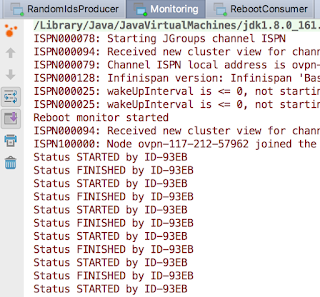
Running the application, we can monitor the logs
Each clustered application contains - or embeds - an Infinispan instance. Under the hood, the 3 Infinispan instances will form a cluster.


What if I need to scale


Imagine you need to scale the Reboot Consumer application. We can run it multiple times, let’s say 2 more times. The two new instances will join the cluster. In this case, we have “ID-93EB” ”ID-45B8” and “ID-247A”, so now we have a cluster of 5. It's very simple but if we have a look to the monitoring console, we will notice reboots are now happening in parallel.

3 Reboot Consumers


As I mentioned before, this example is a dummy application. But in real life you could need to trigger a process from a verticle that runs multiple times and need to be sure this process is happening just once at a time. How can we fix this ? We can use Vert.x Shared Data structures API.

Shared data API to rescue


In this particular case, we are going to use a clustered lock. Using the lock, we can now synchronise the reboots among the 3 nodes.


Using Shared Data API, one reboot at a time

Vert.x clustered lock in this example is using an emulated version of the new Clustered Lock API of Infinispan introduced in 9.2 which has been freshly released. I will come back to share about this API in particular in further blog posts. You can read about it on the documentation or run the infinispan-simple-tutorial.

One node at a time


When clustering applications with Vert.x, there is something you need to take care of. It is important to understand that each node contains an instance of the datagrid. This means that scaling up and down needs to be done one at a time. Infinispan, as other datagrids, reshuffles the data when a new node joins or leaves a cluster. This process is done following a distributed hashing algorithm, so not every data is moved around, just the data that is supposed to live in the new node, or the data owned by a leaving node. If we just kill a bunch of nodes without taking care of the cluster, consequences can be harming! This is something quite obvious when dealing with databases : we just don’t kill a bunch of database instances without taking care of every instance at a time. Even when Infinispan data is only in memory we need to take care about it in the same way. Openshift, which is built on top of Kubernetes, helps dealing properly and safely with these scale up and down operations.


Conclusions


As you have seen, creating clustered applications with Vert.x and Infinispan is very straightforward. The clustered event bus is very powerful. In this example we have seen how to use a clustered lock, but other shared data structures built on top of Counters are available.


About the Vert.x Infinispan Cluster Manager status


At the time of this writing, Infinspan 9.2.0.Final has been released. From vert.x-infinispan cluster manager point of view, before Vert.x 3.6 (which is not out yet) the cluster manager is using Infinispan 9.1.6.final and it’s using an emulation layer for locks and counters. In this tutorial we are using Vert.x 3.5.1 version.

This tutorial will be updated with the version using Infinispan 9.2 as soon as the next vert.x-infinispan will be released, which will happen in a few months. Meanwhile, stay tuned!

Tuesday, 13 March 2018

Final release for Hotrod clients C++ and C# 8.2.0 are out!

We're pleased to announce the availability of the 8.2.0.Final release of the C++ and C# Hotrod clients.
Here is what happened in the 8.2.0 episode:

C++
  • SASL: PLAIN, MD5, EXTERNAL, GSSAPI (linux only)
  • Continuous Queries
  • getAll operation
  • simplified remote exec API

C#
  • SASL: PLAIN, MD5, EXTERNAL
  • Continuous Queries
  • GetAll operation
  • simplified remote exec API

You can find more info and even the binaries at the usual places [1][2][3][4]

In the backstage people are already working on the 8.3.0 episode, you can partecipate expressing your opinion or adding your ideas here [5][6].

Thank you for reading.

The Infinispan Team

[1] Project Issues
[2] C++ Source
[3] C# Source
[4] Download
[5] C++ Features List for 8.3.0
[6] C# Features List for 8.3.0